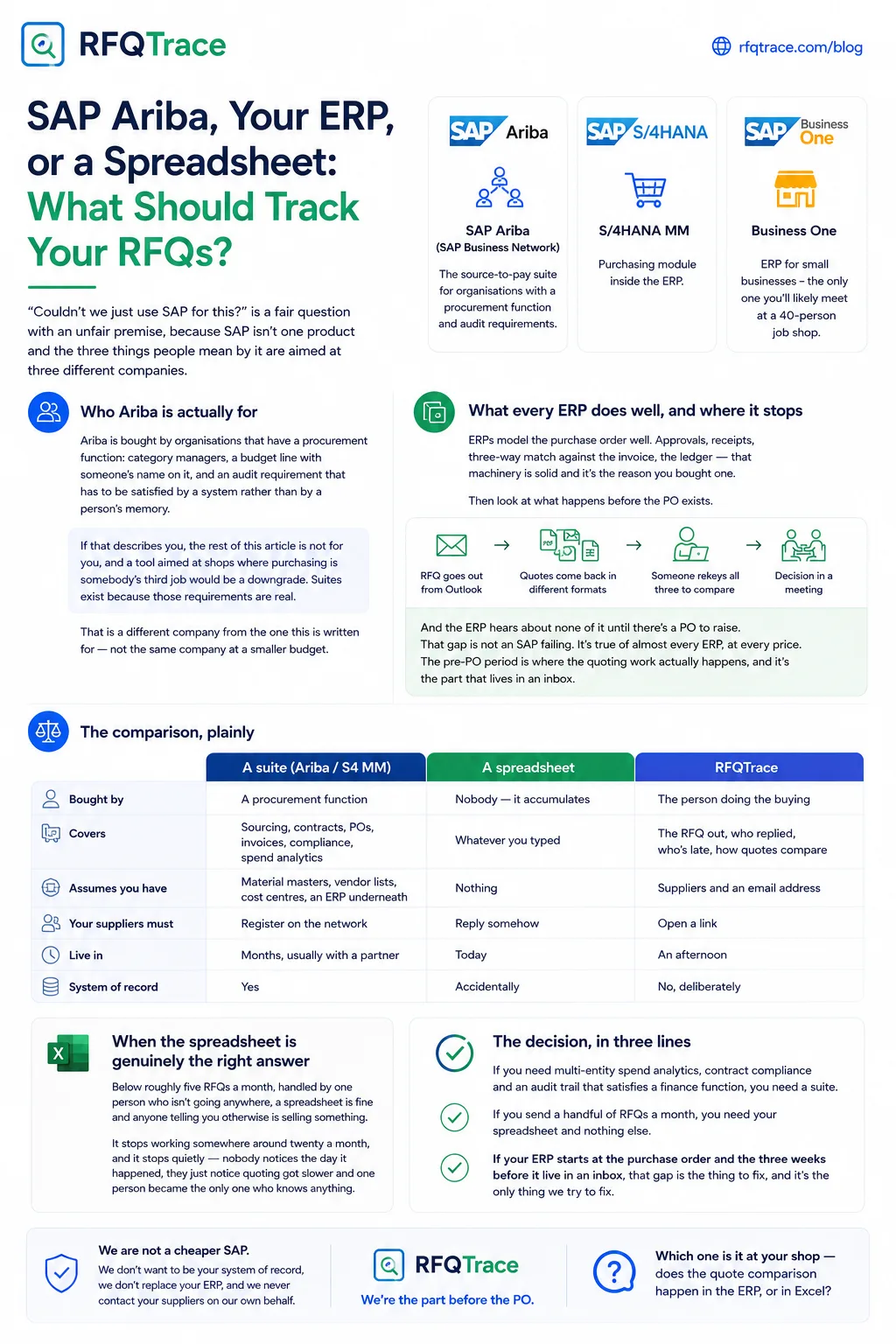
SAP Ariba, Your ERP, or a Spreadsheet: What Should Track Your RFQs?
SAP isn't one product, an ERP starts at the purchase order, and a spreadsheet is genuinely fine below a certain volume. An honest comparison for small manufacturers.
Read more →Practical notes on RFQ management, supplier quote comparison, and procurement — written for the people actually running purchasing at small and mid-size manufacturers.
SAP isn't one product, an ERP starts at the purchase order, and a spreadsheet is genuinely fine below a certain volume. An honest comparison for small manufacturers.
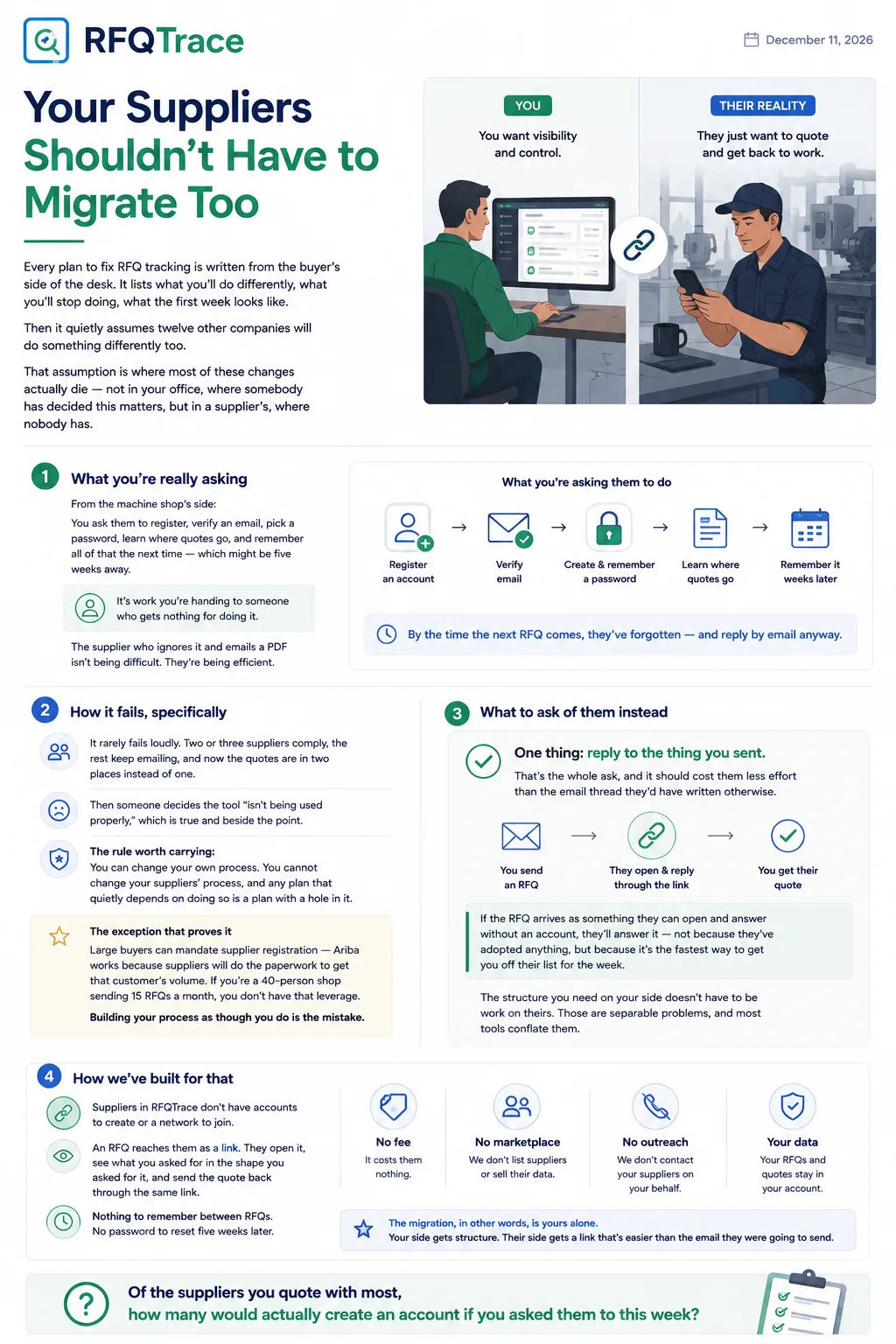
Read more →Most procurement rollouts fail on the supplier side, not yours. If your change asks twelve small shops to register for something, you've handed them work to ignore.
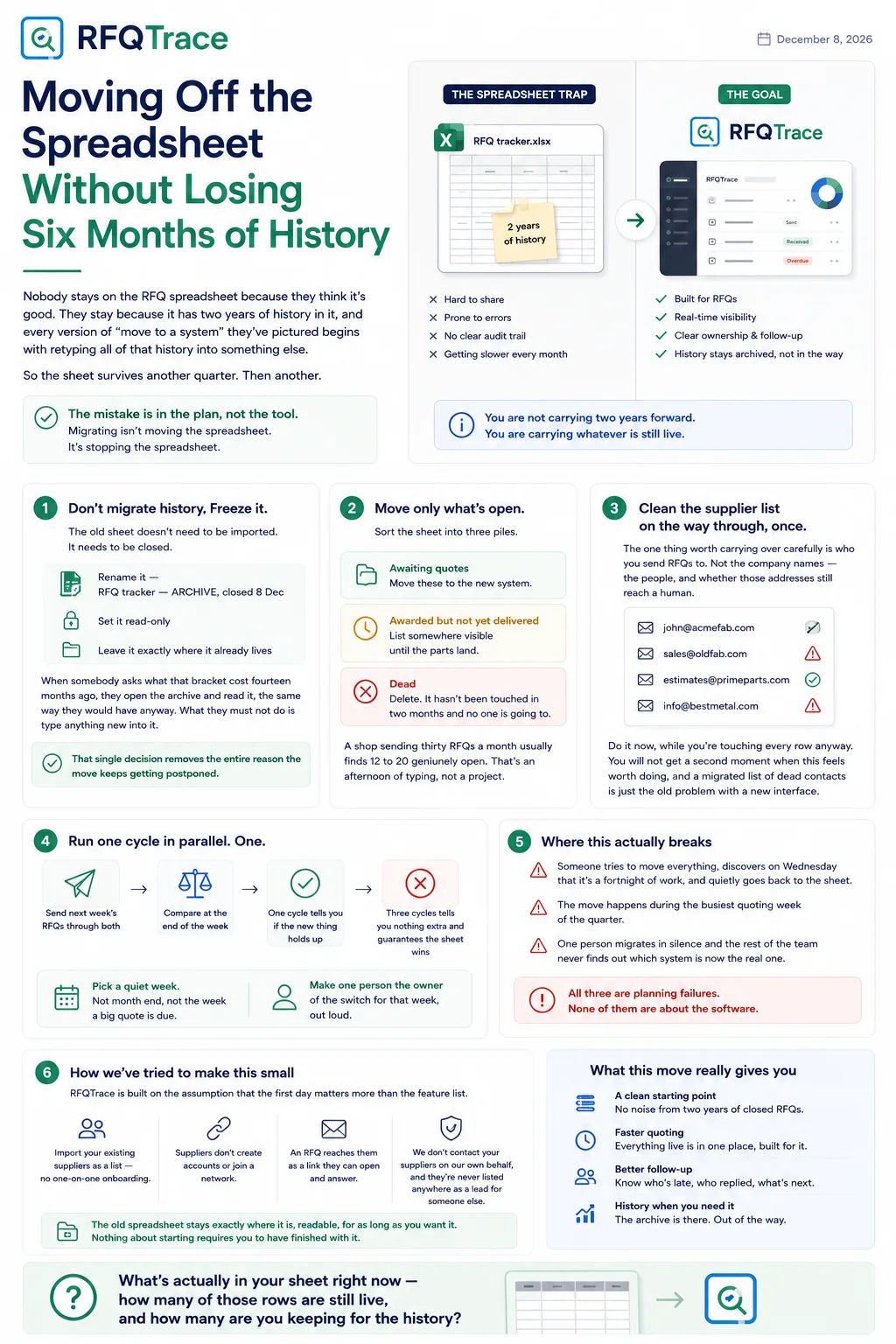
Read more →The spreadsheet isn't hard to replace — the history in it is. Freeze the old sheet, move only what's open, and run one quoting cycle in parallel.
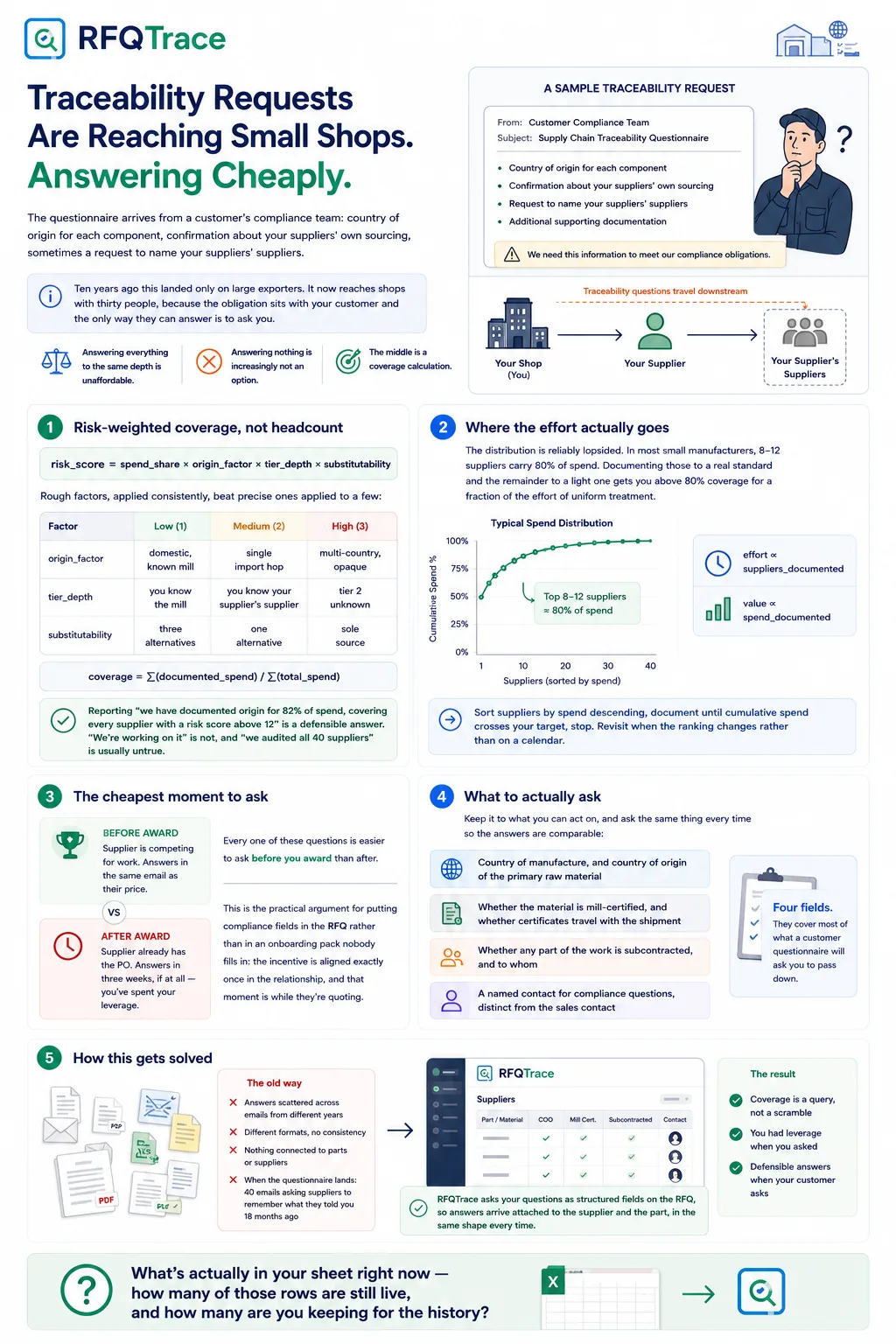
Read more →Risk-weighted coverage instead of auditing everyone, the arithmetic for where to spend the effort, and why the RFQ is the cheapest place to ask.
Read more →Faster turnaround, wider variance, and more quotes nobody read before sending — plus the checks that catch an estimate the estimator didn't.
Read more →Expected annual loss from a sole supplier, what a second source actually costs to qualify, and the payback calculation that decides it.
Read more →The break-even duty rate for each sourcing decision, a sensitivity table, and why the answer is a query rather than a project.
Read more →How to estimate embedded emissions for a machined part, what it adds to landed cost, and why the RFQ is where the data has to be captured.
Read more →Win rate per supplier, the diminishing return on each extra quote, and the arithmetic for when a fourth bidder stops being worth asking.
Read more →How to normalise past quotes into an index, separate real price drift from mix changes, and flag the quote that doesn't fit — with the arithmetic.
Read more →A four-term model that gets you within 15% of a machined part's real price — and turns every quote you receive into calibration data.
Read more →Unit price is one term in a five-term equation. Here is the arithmetic for freight, MOQ, tooling and payment terms, worked end to end.
Read more →A formula for reading the gap between your cheapest and dearest quote, the three thresholds that matter, and how to find which line item caused it.
Read more →People change jobs. Your supplier list doesn't. Here's how to find the dead contacts before an urgent RFQ finds them for you.
Read more →Most buyers say nothing when a supplier loses a bid. It's understandable, it's easy, and it's why your response rate drops.
Read more →Most RFQ processes end at the award. The half hour after it is where the next quote gets faster and the next decision gets easier.
Read more →Count the emails it takes to get one quote back. Most of them exist to fix problems the first email created.
Read more →When a customer asks for a status update and it takes ten minutes to answer, the problem isn't the ten minutes. It's that you didn't know until they asked.
Read more →At most small manufacturers, purchasing knowledge lives in one person's head and inbox. Here's what actually walks out with them, and what to do about it now.
Read more →Repeat parts get requoted from scratch because last year's quotes are unfindable. Here's what having the history changes about the conversation.
Read more →A quote valid for 30 days sounds generous until you notice the decision took 34. Here's why quote validity keeps running out, and what it costs when it does.
Read more →A supplier who was reliable last quarter has gone quiet on your last two RFQs. Here's how to read it, and what to do before you write them off.
Read more →The RFQs that cost you money aren't the ones you lose on price — they're the ones that went quiet and nobody noticed for a week.
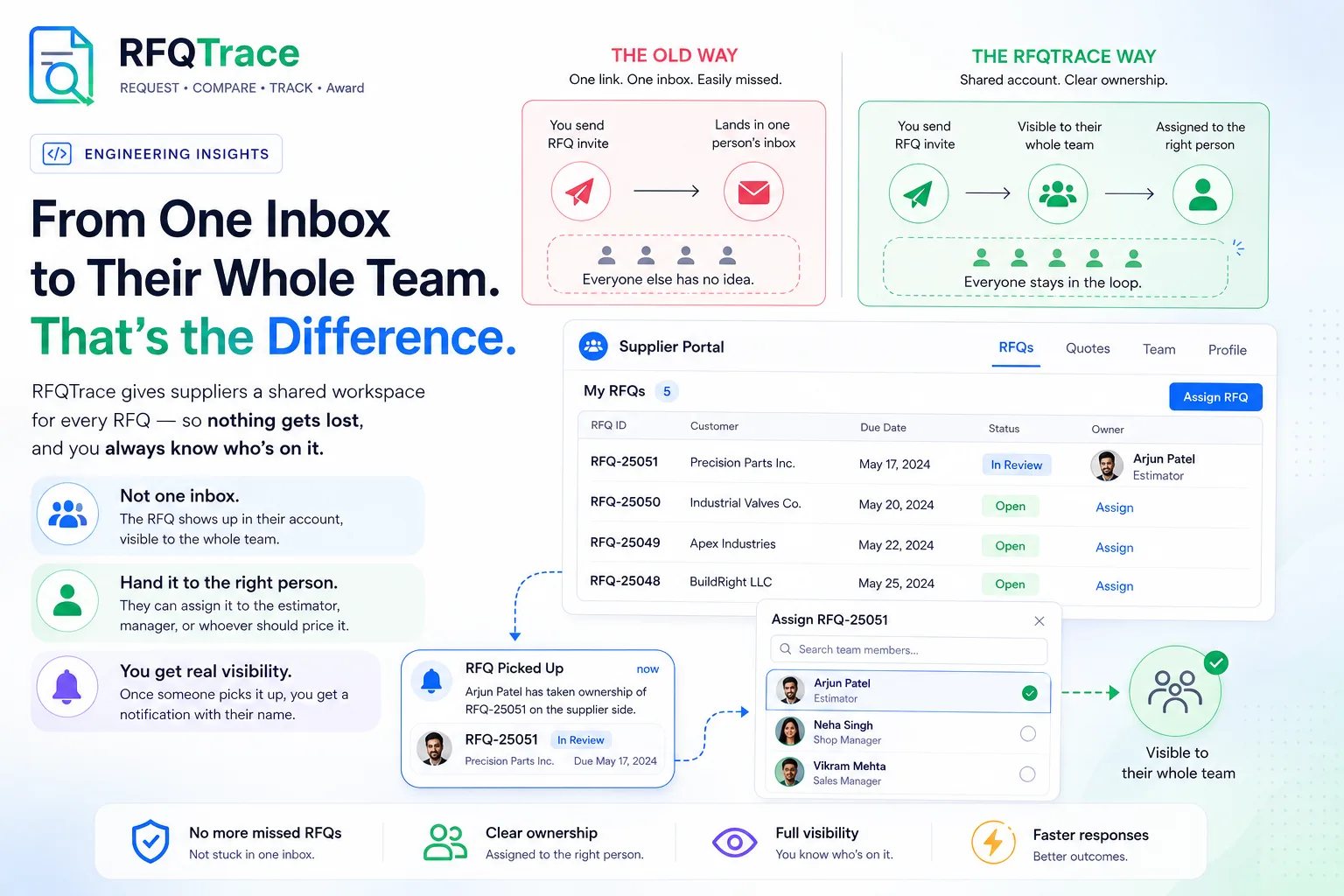
Read more →When a supplier invite used to land in one inbox, the RFQ lived or died with whoever opened that email. Now it lives inside their account, visible to their whole team — and you find out who's actually working it.
Read more →Manual quoting pulls reps across four systems for 90 minutes per RFQ. An ERP-connected AI assistant does it in five. Here's what that actually requires.
Read more →Most small manufacturers don't have a procurement department — purchasing is one of several jobs someone's already doing. Here's how to make that actually work.
Read more →Sourcing from a job shop and sourcing from a contract manufacturer aren't the same process, even when the RFQ looks similar on paper. Here's what actually differs.
Read more →Response speed looks like a minor convenience, but it's one of the most reliable signals of how a supplier will perform once the job is actually awarded.
Read more →A practical checklist for bringing a new supplier into rotation — the questions worth asking before their first RFQ, not after.
Read more →Too few suppliers and you're not getting a real market price. Too many and you're wasting everyone's time on quotes that never had a chance. Here's how to actually decide.
Read more →A no-frills RFQ template covering exactly what a supplier needs to quote accurately — copy it, fill in the blanks, send it.
Read more →A quote that comes back three days late looks like a minor annoyance. Here's what it actually costs once it hits your customer's schedule.
Read more →You don't need an ERP implementation to know which suppliers actually deliver. Here's what to track and how to do it at small-manufacturer scale.
Read more →RFQ, RFP, and RFI get used interchangeably, but they're not the same document. Here's the actual difference, and how to tell which one your sourcing situation calls for.
Read more →Vague RFQs get vague quotes. Here's exactly what to include so suppliers can price your job right the first time, without a round of back-and-forth.
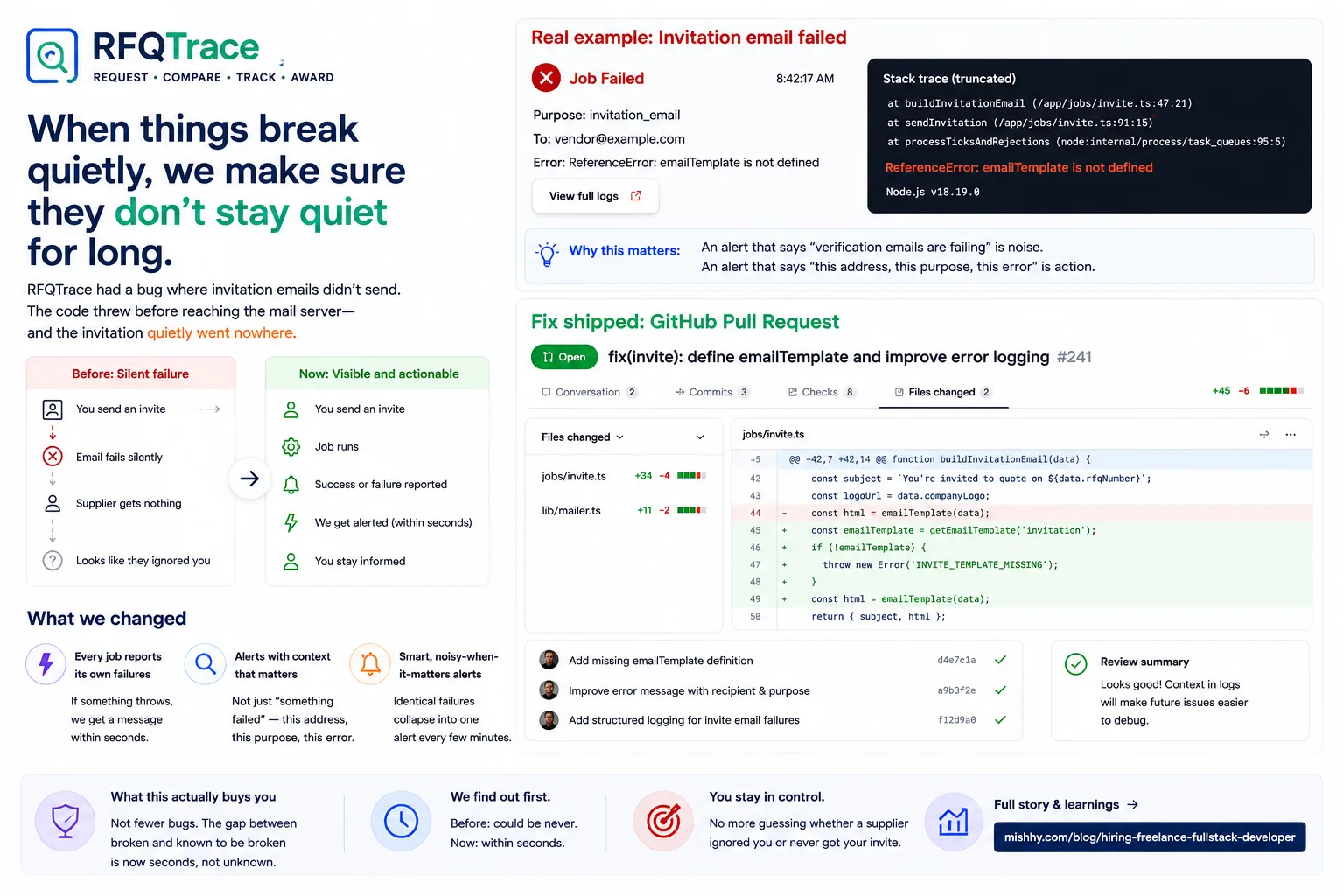
Read more →The worst failures aren't the ones that show an error. They're the ones where nothing happens at all — an invitation that never sends, and nobody knows.
Read more →How to actually compare supplier quotes side-by-side without an afternoon of copy-pasting three different formats into one sheet.
Read more →Why a self-serve supplier quote portal beats email back-and-forth, and what it actually changes about how RFQs get chased and quoted.
Read more →Five concrete signs your purchasing team has outgrown email for supplier RFQs and quotes — and what to do about it.
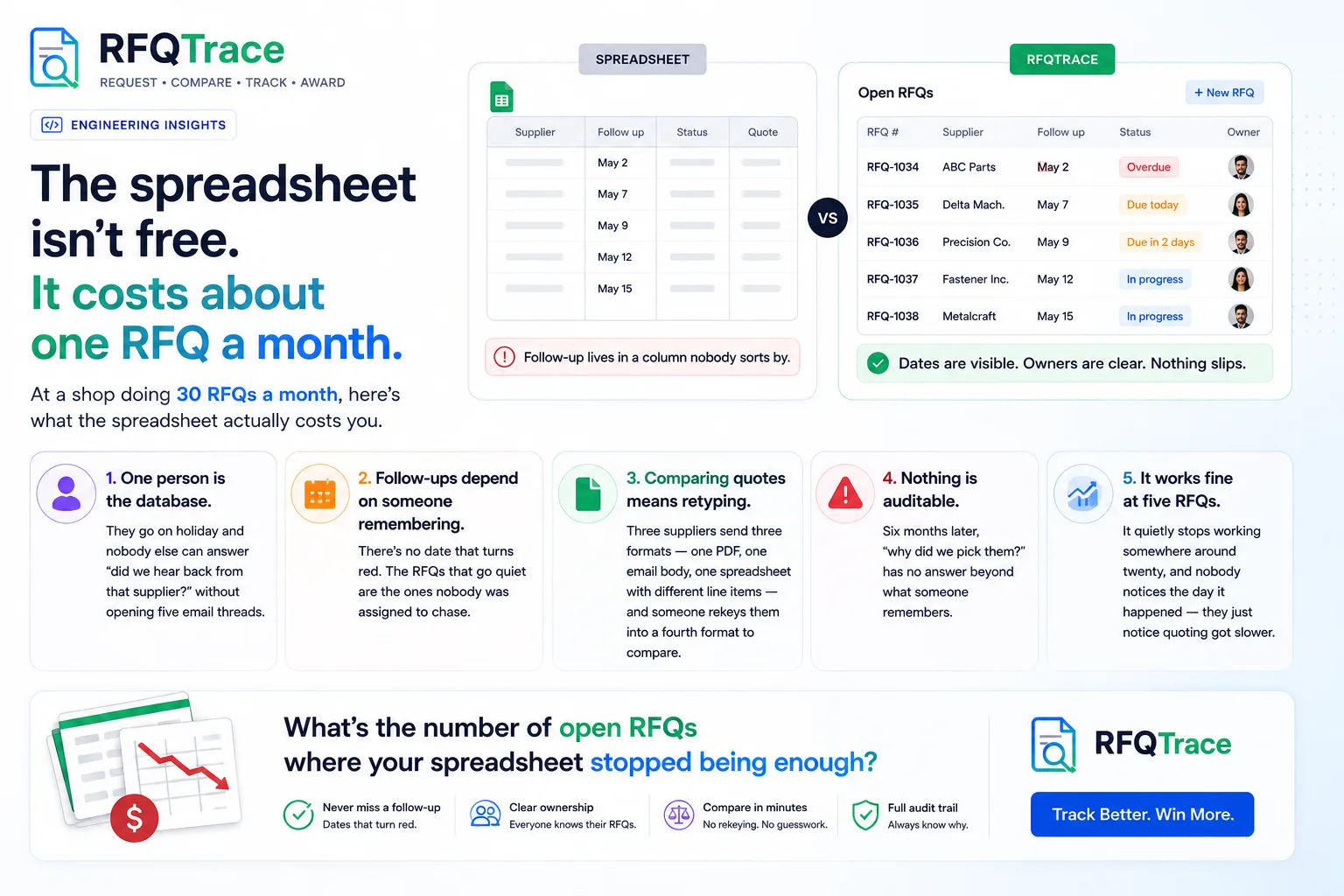
Read more →Spreadsheets look free until you count the missed follow-ups, the single point of failure, and the hours lost retyping quotes to compare them.
Read more →Enterprise procurement software solves a different company's problem. Here's what actually matters for RFQ management at 10–100 RFQs a month.
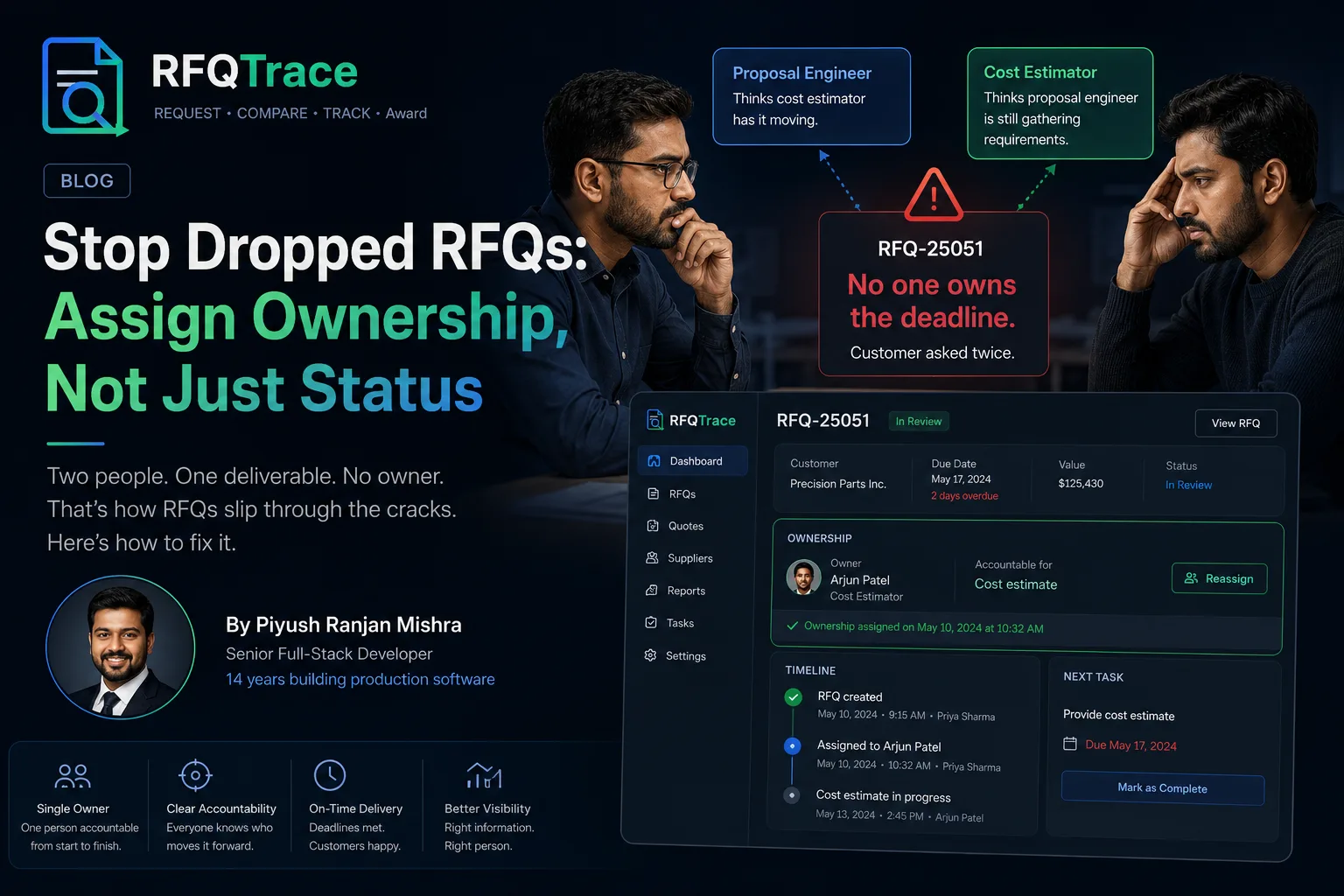
Read more →When an RFQ has two people working on it and neither owns the deadline, it doesn't get worked twice as fast — it goes quiet. Here's why ownership, not coordination, is the actual fix.
Read more →