
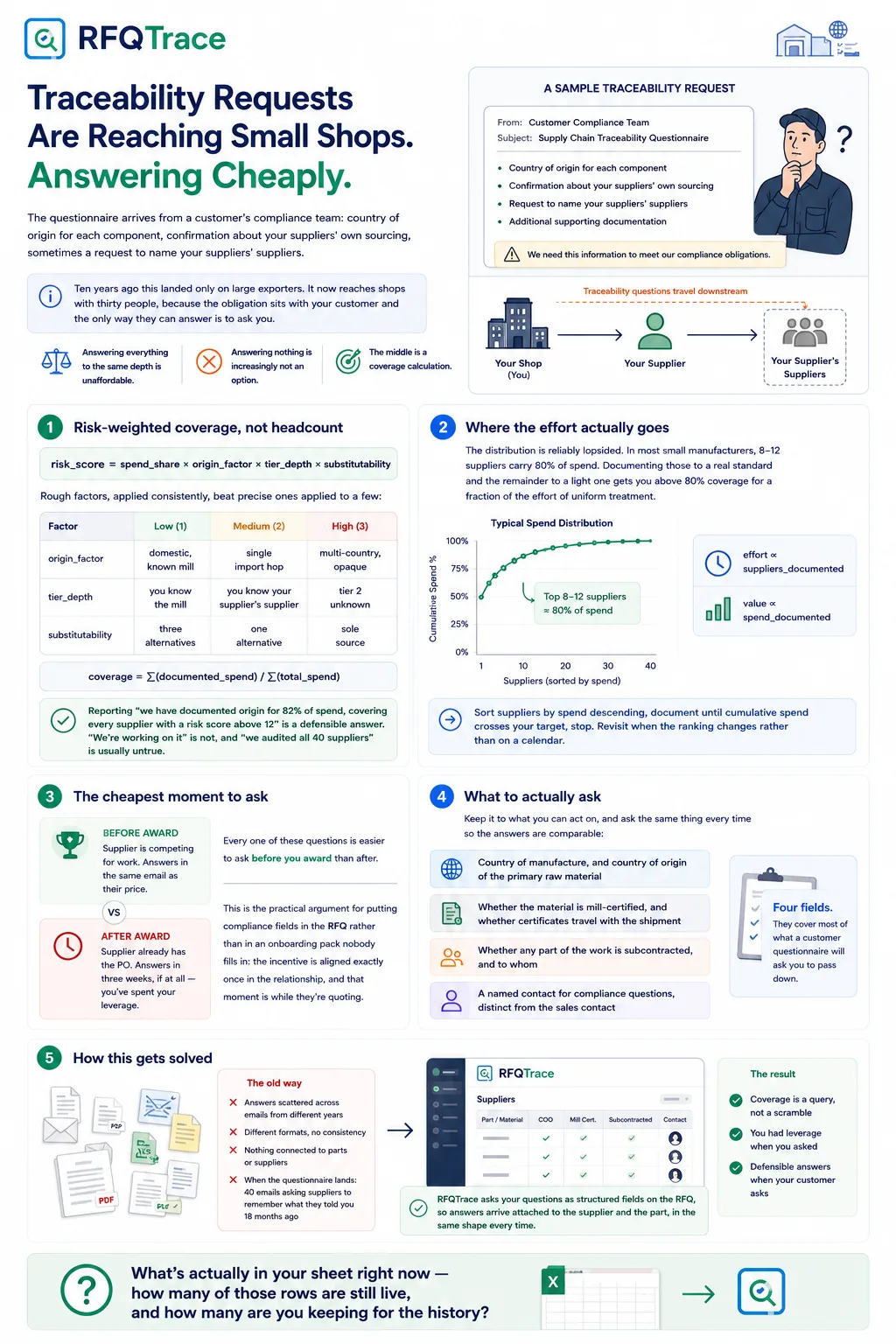
The questionnaire arrives from a customer's compliance team: country of origin for each component, confirmation about your suppliers' own sourcing, sometimes a request to name your suppliers' suppliers.
Ten years ago this landed only on large exporters. It now reaches shops with thirty people, because the obligation sits with your customer and the only way they can answer is to ask you.
Answering everything to the same depth is unaffordable. Answering nothing is increasingly not an option. The middle is a coverage calculation.
Risk-weighted coverage, not headcount
Auditing every supplier equally spends the same effort on a local shop making brackets from domestic bar stock as on a multi-tier import. Weight instead:
risk_score = spend_share × origin_factor × tier_depth × substitutability
Rough factors, applied consistently, beat precise ones applied to a few:
| Factor | Low (1) | Medium (2) | High (3) |
|---|---|---|---|
| origin_factor | domestic, known mill | single import hop | multi-country, opaque |
| tier_depth | you know the mill | you know your supplier's supplier | tier 2 unknown |
| substitutability | three alternatives | one alternative | sole source |
Then coverage is the number that answers your customer:
coverage = Σ(documented_spend) / Σ(total_spend)
Reporting "we have documented origin for 82% of spend, covering every supplier with a risk score above 12" is a defensible answer. "We're working on it" is not, and "we audited all 40 suppliers" is usually untrue.
Where the effort actually goes
The distribution is reliably lopsided. In most small manufacturers, 8–12 suppliers carry 80% of spend. Documenting those to a real standard and the remainder to a light one gets you above 80% coverage for a fraction of the effort of uniform treatment.
effort ∝ suppliers_documented
value  ∝ spend_documented
Sort suppliers by spend descending, document until cumulative spend crosses your target, stop. Revisit when the ranking changes rather than on a calendar.
The cheapest moment to ask
Every one of these questions is easier to ask before you award than after. A supplier competing for work answers a country-of-origin question in the same email as their price. A supplier who already has the PO answers it in three weeks, if at all — you've spent your leverage.
This is the practical argument for putting compliance fields in the RFQ rather than in an onboarding pack nobody fills in: the incentive is aligned exactly once in the relationship, and that moment is while they're quoting.
What to actually ask
Keep it to what you can act on, and ask the same thing every time so the answers are comparable:
- Country of manufacture, and country of origin of the primary raw material
- Whether the material is mill-certified, and whether certificates travel with the shipment
- Whether any part of the work is subcontracted, and to whom
- A named contact for compliance questions, distinct from the sales contact
Four fields. They cover most of what a customer questionnaire will ask you to pass down.
How this gets solved
The reason this becomes a scramble is that the answers, when they exist, are scattered across onboarding emails from different years in different formats, and nothing connects them to the parts they apply to.
RFQTrace asks your questions as structured fields on the RFQ, so answers arrive attached to the supplier and the part, in the same shape every time. When the customer questionnaire lands, coverage is a query over data you collected while you had leverage — not forty emails asking suppliers to remember what they told you eighteen months ago.