
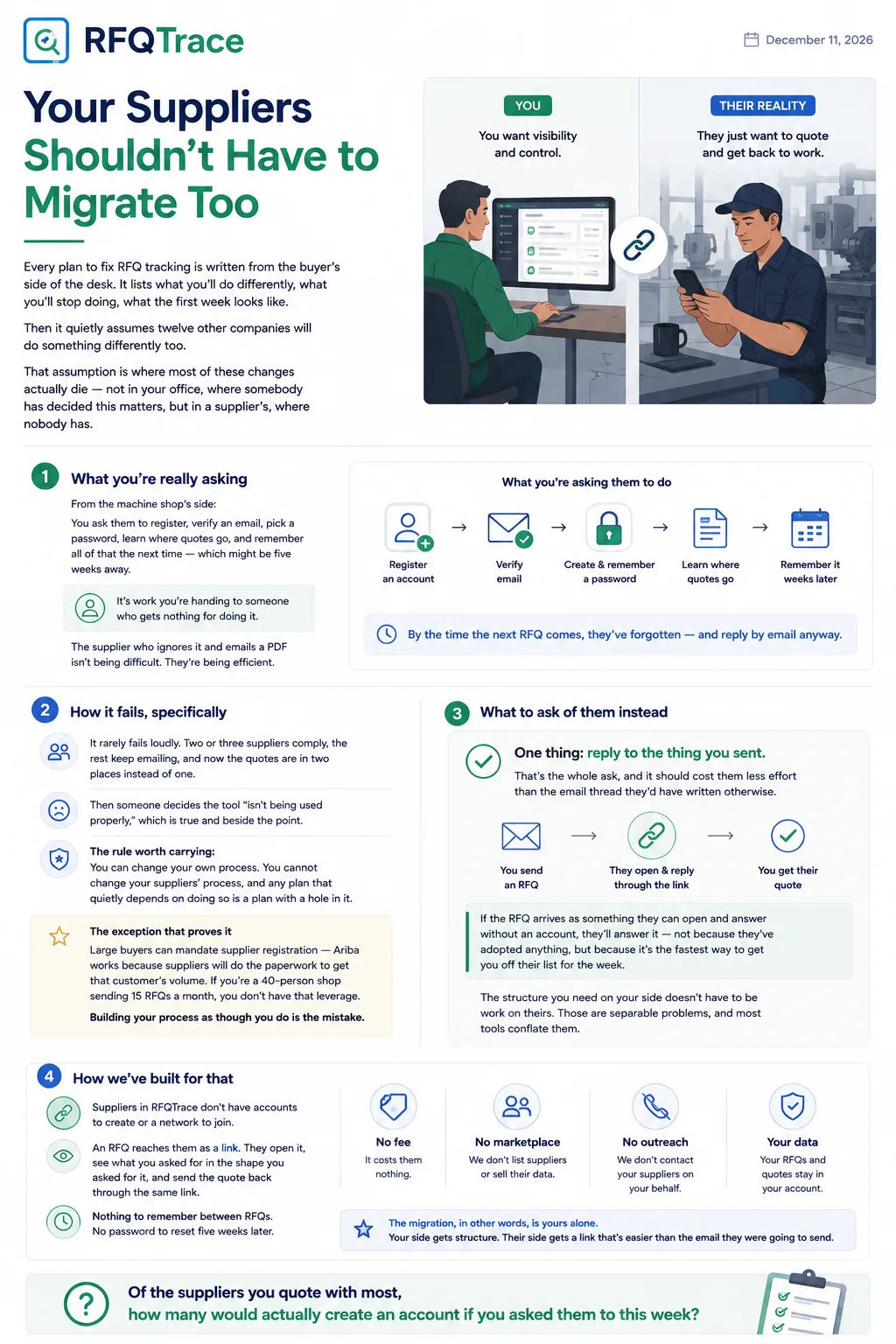
Every plan to fix RFQ tracking is written from the buyer's side of the desk. It lists what you'll do differently, what you'll stop doing, what the first week looks like.
Then it quietly assumes twelve other companies will do something differently too.
That assumption is where most of these changes actually die — not in your office, where somebody has decided this matters, but in a supplier's, where nobody has.
What you're really asking
Look at the request from the machine shop's side. They have eleven customers. You are one of them. Their estimator quotes from a phone between jobs, and their "system" is an inbox and whatever the customer sent.
Now you ask them to register an account, verify an email, pick a password, learn where quotes go, and remember all of that the next time — which might be five weeks away, by which point they've forgotten and reply by email anyway.
None of that is unreasonable on its own. It's just work, and it's work you're handing to someone who gets nothing for doing it. The supplier who ignores it and emails a PDF isn't being difficult. They're being efficient.
How it fails, specifically
It rarely fails loudly. Two or three suppliers comply, the rest keep emailing, and now the quotes are in two places instead of one. That's worse than where you started, because before there was at least one reliable place to look.
Then someone decides the tool "isn't being used properly," which is true and beside the point. The tool was asking for a change of habit from people who never agreed to it.
The rule worth carrying: you can change your own process. You cannot change your suppliers' process, and any plan that quietly depends on doing so is a plan with a hole in it.
Note the exception that proves it. Large buyers can mandate supplier registration — Ariba works precisely because a supplier who wants that customer's volume will do the paperwork. That leverage is real, and if you're a forty-person shop sending fifteen RFQs a month, you don't have it. Building your process as though you do is the mistake.
What to ask of them instead
One thing: reply to the thing you sent.
That's the whole ask, and it should cost them less effort than the email thread they'd have written otherwise. If the RFQ arrives as something they can open and answer without an account, they'll answer it — not because they've adopted anything, but because it's the fastest way to get you off their list for the week.
The structure you need on your side doesn't have to be work on theirs. Those are separable problems, and most tools conflate them.
How we've built for that
Suppliers in RFQTrace don't have accounts to create or a network to join. An RFQ reaches them as a link. They open it, see what you asked for in the shape you asked for it, and send the quote back through the same link.
Nothing to remember between RFQs. No password to reset five weeks later. No fee, and no marketplace — we don't contact your suppliers on our own behalf, and they're never listed anywhere as a lead for someone else.
The migration, in other words, is yours alone. Your side gets structure. Their side gets a link that's easier than the email they were going to send.
Of the suppliers you quote with most, how many would actually create an account if you asked them to this week?