
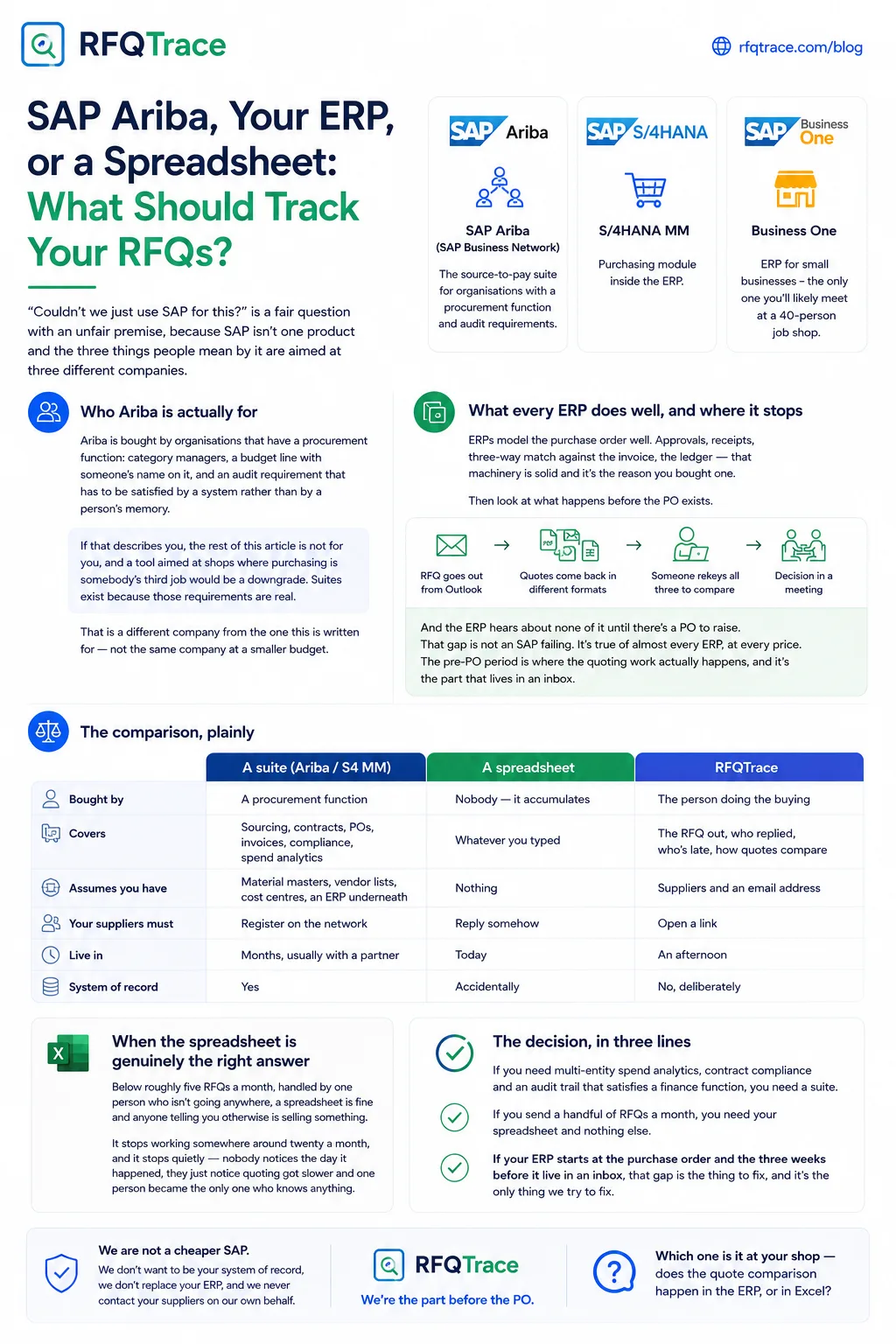
"Couldn't we just use SAP for this?" is a fair question with an unfair premise, because SAP isn't one product and the three things people mean by it are aimed at three different companies.
SAP Ariba, now sitting on SAP Business Network, is the source-to-pay suite where enterprise sourcing events live. S/4HANA MM is the purchasing module inside the ERP itself. Business One is the small-business ERP, and it's the only one of the three you're likely to meet at a forty-person job shop.
Who Ariba is actually for
Ariba is bought by organisations that have a procurement function: category managers, a budget line with someone's name on it, and an audit requirement that has to be satisfied by a system rather than by a person's memory.
If that describes you, the rest of this article is not for you, and a tool aimed at shops where purchasing is somebody's third job would be a downgrade. Suites exist because those requirements are real.
That is a different company from the one this is written for — not the same company at a smaller budget.
What every ERP does well, and where it stops
ERPs model the purchase order well. Approvals, receipts, three-way match against the invoice, the ledger — that machinery is solid and it's the reason you bought one.
Then look at what happens before the PO exists.
The RFQ goes out from Outlook. Three quotes come back — one PDF, one in an email body, one spreadsheet with the line items in a different order. Somebody rekeys all three into a fourth format so they can be compared. A decision gets made in a meeting. And the ERP hears about none of it until there's a PO to raise.
That gap is not an SAP failing. It's true of almost every ERP, at every price. The pre-PO period is where the quoting work actually happens, and it's the part that lives in an inbox.
The comparison, plainly
| A suite (Ariba / S4 MM) | A spreadsheet | RFQTrace | |
|---|---|---|---|
| Bought by | A procurement function | Nobody — it accumulates | The person doing the buying |
| Covers | Sourcing, contracts, POs, invoices, compliance, spend analytics | Whatever you typed | The RFQ out, who replied, who's late, how quotes compare |
| Assumes you have | Material masters, vendor lists, cost centres, an ERP underneath | Nothing | Suppliers and an email address |
| Your suppliers must | Register on the network | Reply somehow | Open a link |
| Live in | Months, usually with a partner | Today | An afternoon |
| System of record | Yes | Accidentally | No, deliberately |
When the spreadsheet is genuinely the right answer
Below roughly five RFQs a month, handled by one person who isn't going anywhere, a spreadsheet is fine and anyone telling you otherwise is selling something. It stops working somewhere around twenty a month, and it stops quietly — nobody notices the day it happened, they just notice quoting got slower and one person became the only one who knows anything.
The decision, in three lines
If you need multi-entity spend analytics, contract compliance and an audit trail that satisfies a finance function, you need a suite. If you send a handful of RFQs a month, you need your spreadsheet and nothing else. If your ERP starts at the purchase order and the three weeks before it live in an inbox, that gap is the thing to fix, and it's the only thing we try to fix.
We are not a cheaper SAP. We don't want to be your system of record, we don't replace your ERP, and we never contact your suppliers on our own behalf. We're the part before the PO.
Which one is it at your shop — does the quote comparison happen in the ERP, or in Excel?